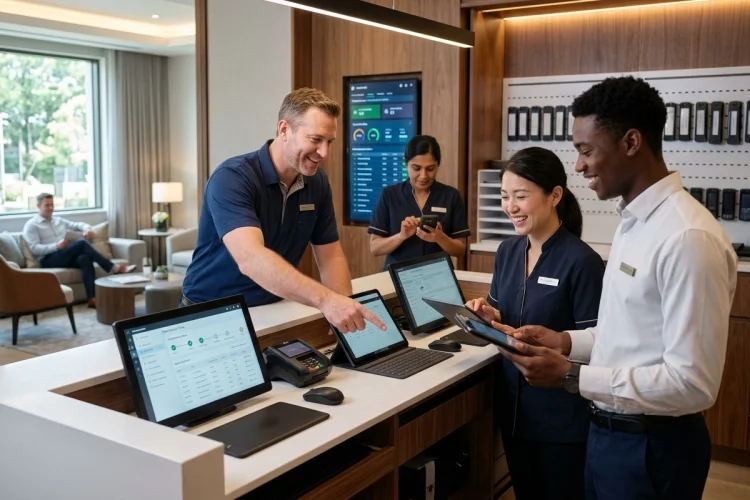
Hotels often add technology to solve operational problems. Then another platform is added to connect the first one, a spreadsheet appears to fill a reporting gap, and employees eventually need several screens just to complete one guest request.
That is why How Hotels Reduce Operating Complexity is increasingly a question of service design, not simply cost cutting. Hotels need fewer disconnected workflows, clearer systems, smarter automation, and better decisions about where employees create the most value.
When done well, simplification can actually make service feel more personal because staff spend less time fighting operational friction.
Reduce Technology Fragmentation Before Adding More Tools
A large technology stack can create the illusion of sophistication while making daily operations harder.
Mews reported in May 2026 that the average hotel runs on roughly eight to ten different software vendors, covering functions such as PMS, revenue management, distribution, messaging, check-in, POS, and receivables.
Every separate platform can create another login, another integration, another training requirement, and another place where data can become inconsistent.
Hotels should therefore audit technology based on function rather than brand name.
If three systems contain overlapping guest profiles or two platforms perform nearly identical communication tasks, consolidation may be possible.
The purpose is not achieving the smallest technology stack imaginable. It is reducing systems that create more complexety than operational value.
Build One Reliable Source of Guest Information
Service becomes unnecessarily difficult when employees cannot easily find the information they need.
A guest may have already provided a room preference during booking, repeated it in an email, and mentioned it again at check-in because the information never moved between systems.
That is not personalization. It is organizational friction being transferred to the customer.
Integrated platforms can create a more consistent guest profile covering reservations, preferences, loyalty activity, and selected spending behavior.
Resorts World Las Vegas, for example, described using a common cloud platform to centralize information across hotel, restaurant, casino, and loyalty operations so employees could provide more informed service.
A useful guest data strategy should reduce repeated questions and help employees anticipate straightforward needs.
The hotel feels more personal even though the underlying process becomes simpler.
Automate Transactions, Not Hospitality
Automation has its highest value in predictable, repetitive activities.
Payment processing, confirmation messages, room assignments, reporting, routine guest requests, inventory updates, and certain housekeeping tasks can often be handled partly or fully by technology.
Oracle describes hotel automation as a way to free employees from routine tasks so they can focus more attention on guests.
However, the hotel should distinguish between a transaction and a relationship.
A guest checking an invoice may want a fast digital option. Someone celebrating an anniversary or dealing with a disrupted trip may value empathy and personal help.
Mews’ 2026 survey reinforces this distinction: although AI use was widespread across participating properties, most respondents still wanted the front-desk welcome and check-in to retain meaningful human involvement.
Automation should make service teams more available, not less visible.
That is an important principel of hospitality technology.
Simplify the Guest Journey From the Outside In
Hotel processes are frequently designed around departments.
Guests do not think that way.
They simply want to arrive, access the room, get what they need, enjoy the stay, and leave without unnecessary friction.
Hotels can therefore redesign operations by mapping the experience from the customer’s perspective.
Remove Repeated Decisions
Consider check-in.
Does every guest need exactly the same process? A returning loyalty guest with a prepaid reservation may be happy with mobile arrival, while a first-time leisure traveler may prefer staff guidance.
Providing two simple pathways can sometimes be more effective than forcing everyone through one complicated process.
The same logic works with housekeeping.
Instead of creating complicated daily discussions about service frequency, hotels can present clear options while automatically communicating the guest’s choice to housekeeping.
Shiji’s 2026 hospitality outlook argues that hotels are increasingly designing operations backward from important guest moments and reducing processes that force guests to adapt to internal hotel structures.
Good service design makes complexity disappear from the customer’s view.
Consolidate Vendors Where It Improves Operations
Hotels work with a huge number of external suppliers.
Laundry providers, maintenance contractors, food distributors, technology companies, amenities suppliers, cleaning vendors, payment providers, and marketing partners can all create separate contracts, invoices, service standards, and communication channels.
Vendor consolidation can simplify procurement and administration.
However, fewer vendors are not automatically better.
A hotel should consolidate when one supplier can deliver consistent quality, competitive economics, reliable support, and easier administration without creating excessive dependency.
For example, using one integrated technology provider for several closely connected functions may reduce data integration problems.
Oracle reported that Absolute Hotel Services selected connected PMS and POS platforms across its branded portfolio partly to centralize operations and guest data.
The right goal is fewer unnecessary relationships, not blindly fewer suppliers.
Give Employees Clearer Decision Authority
Manager approvals can become one of the largest hidden sources of complexity.
An employee discovers a guest problem, asks a supervisor for permission, the supervisor contacts another department, and twenty minutes pass before anyone acts.
Hotels can reduce this friction by defining clear decision rights.
For example, front-line employees might receive authority to offer selected service recovery options below a defined value without managerial approval.
Maintenance teams may receive clear priority rules for guest-facing problems.
Housekeeping supervisors can be empowered to make operational room-status decisions within established guidelines.
This creates speed without eliminating control.
Clear authority also reduces employee frustration because staff understand what they can solve themselves and what genuinely requires escalation.
The process becomes more consistant while service feels more responsive.
Use Predictive Operations Instead of Constant Firefighting
Complexity increases when hotel teams spend the day reacting to problems.
A maintenance failure creates emergency calls. Unexpected housekeeping demand creates overtime. Restaurant inventory shortages require urgent purchasing.
Predictive operations can reduce those surprises.
Hotels can use occupancy forecasts to anticipate housekeeping workload, restaurant reservations to plan staffing, maintenance records to identify recurring equipment problems, and guest-request data to prepare for predictable service peaks.
Industry technology discussions increasingly emphasize this move from reactive to predictive operations. In its 2026 outlook, Shiji identified predictive thinking and operational simplification as major themes for hotels trying to connect technology with guest experience.
Better preparation removes the operational chaos that often leads to rushed or inconsistent service.
Judge Efficiency Through the Guest Experience
An efficiency project should not be considered successful simply because labor hours or software costs decrease.
The guest experience needs to remain stable or improve.
Hotels should track waiting time, service-request completion, room readiness, complaint frequency, review sentiment, employee workload, and guest satisfaction alongside financial savings.
Imagine replacing a staffed process with self-service kiosks.
If waiting times fall and guests appreciate the flexibility, the change is probably working.
If guests regularly become confused and employees spend their time troubleshooting the kiosks, the hotel may have introduced a new form of inefficency.
The ideal operating model is not the one with the fewest people, systems, or procedures.
It is the one that delivers the desired guest experience with the least unnecessary friction.
Understanding How Hotels Reduce Operating Complexity requires more than automation or cutting costs.
Hotels need connected systems, cleaner guest data, clearer decision authority, fewer unnecessary handoffs, and service journeys designed around real customer needs.
Start by identifying one process that frustrates both employees and guests, simplify it end to end, and only then decide whether technology can make the new workflow even better.